
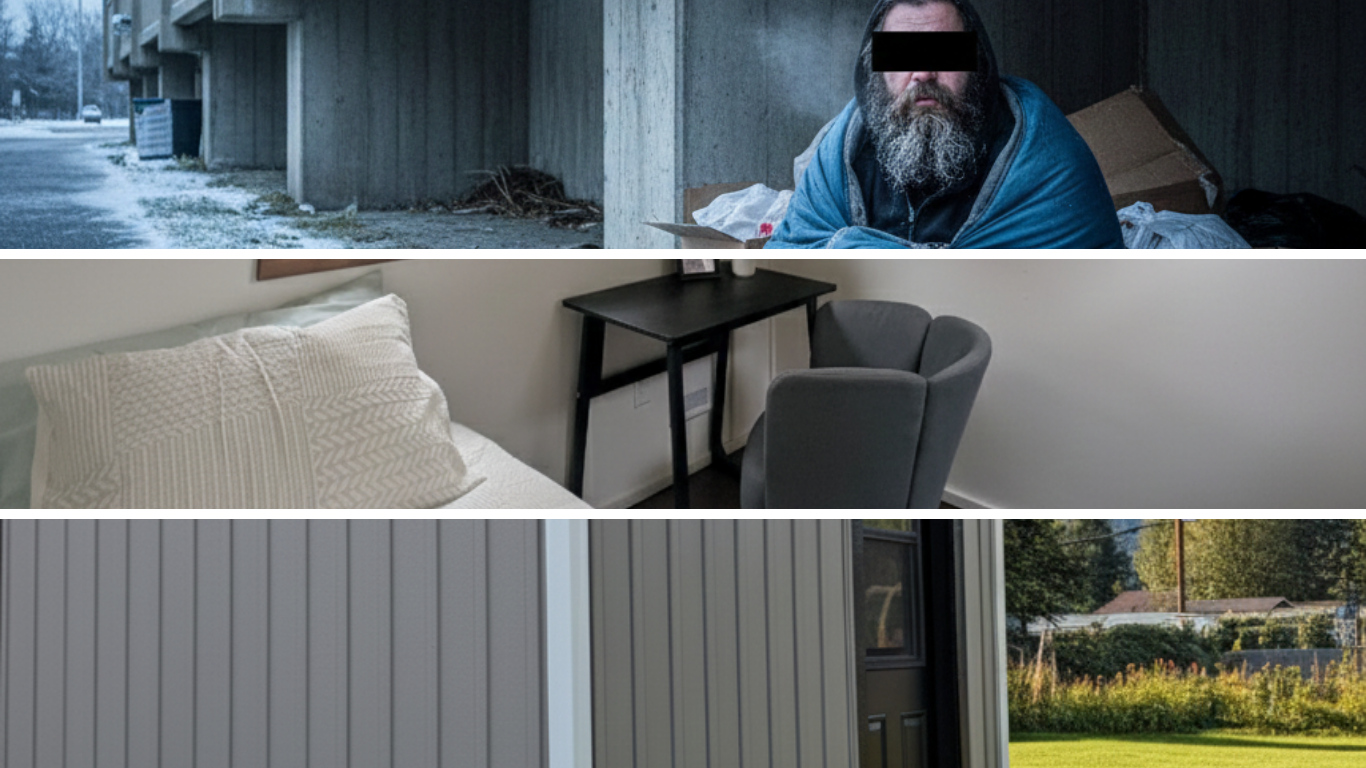
The Winter Mortality Gap: Evolving Our Defense Against the Cold
Every year, as the Canadian temperature drops, municipalities face the immense logistical challenge of the "mortality gap." This is the statistical spike in health risks among vulnerable populations directly correlated to extreme cold exposure. Civic leaders and non-profits work tirelessly to activate emergency protocols, opening warming centers and temporary shelters to keep people safe.
At Anhart, we see the incredible effort that goes into these seasonal operations. Our goal is to support these efforts by offering a new logistical tool: rapidly deployable, custom-engineered micro-housing. We believe that by combining the government's mandate to protect with our specialized modular engineering, we can transition from seasonal management to long-term stability.
Below is a technical, operational, and economic breakdown of how Anhart’s custom units can serve as a permanent asset in the fight against the winter crisis.
The Reality of the Challenge: By the Numbers
The data highlights the severity of the challenge we face together. The cold acts as a force multiplier for health risks, making the work of housing providers critical.
British Columbia: In 2023, the BC Coroners Service reported 458 deaths among people experiencing homelessness. Notably, 28% of these occurred in winter, complicating the efforts of frontline workers. The physical stress of sub-zero temperatures makes recovery from other health issues exponentially harder.
Toronto: In early 2024, data indicated that 30% of deaths among the unhoused occurred outdoors. This underscores the difficulty of reaching everyone with current temporary infrastructure.
The Life Expectancy Gap: The average age of death for a homeless individual in Canada is significantly lower than the national average (approx. 39–50 vs. 82). This discrepancy drives the urgency for all of us—government and private partners alike—to find faster, more durable housing solutions.
1. The Physics of Survival: Advanced Thermal Engineering
Current emergency structures, like retrofitted trailers or tents, struggle against the laws of thermodynamics in a Canadian winter. They require massive energy inputs to stay habitable. Our units are designed to be more efficient, reducing the operational burden on the operator.
Our custom units are built to CSA Z240 MH and CSA A277 standards, specifically targeting Climate Zones 7 and 8.
The Thermal Envelope: We utilize closed-cell spray foam or high-density batting to achieve R-24 in walls and R-40 in roofs. This high-performance insulation ensures the unit holds heat efficiently, reducing utility costs for the municipality or non-profit operator.
Eliminating Thermal Bridging: We use continuous insulation techniques to prevent cold from transferring through the studs. This creates a stable internal environment that protects residents even during extreme cold snaps.
Triple-Pane Glazing: To prevent heat loss and condensation, we install triple-pane, argon-filled windows. This protects the asset from moisture damage and mold, reducing long-term maintenance costs for the housing provider.
2. Rapid Logistics: Extending the Building Season
One of the greatest hurdles for housing development is the "winter bottleneck." Traditional construction is often paused or slowed by frozen ground, limiting how quickly new units can be brought online. Anhart’s modular process is designed to overcome these seasonal constraints.
Parallel Processing: While the site is being permitted and prepared, homes are built simultaneously in our climate-controlled factory. This parallel workflow significantly reduces the timeline from approval to occupancy.
Winter Installation: We utilize Helical Screw Piles which can be installed in frozen ground. This allows us to activate sites in January or February that would otherwise be dormant until May, giving municipalities a way to add capacity exactly when it is needed most.
Plug-and-Play Utilities: Our units are designed for rapid connection to municipal services or temporary holding tanks. This agility allows for deployment in roughly 6-8 weeks, offering a responsive solution to urgent housing needs.
3. The Economic Argument: Building Long-Term Assets
Municipal budgets are finite. Our goal is to help partners maximize the value of every dollar spent on homelessness strategies.
Asset Creation: Renting hotel rooms or heating temporary large-scale facilities are necessary operational expenses, but they don't leave a tangible asset behind. Purchasing modular tiny homes adds permanent assets to the housing portfolio. These units have a lifespan of 40+ years and retain value.
Flexibility and Reuse: Because Anhart units are mobile, they offer strategic flexibility. If a land lease expires or community needs shift, the homes can be relocated rather than demolished. They can be repurposed for different demographics or moved to new sites, ensuring the initial investment continues to serve the community for decades.
The "Housing First" Dividend: Stable, warm housing is the foundation for successful social work. By providing a high-quality environment, we lower the barrier to service delivery. It is easier for support staff to assist residents with health and employment goals when the resident has a fixed, secure address.
Conclusion: Partnering for a Solution
The winter season presents a recurring challenge, but it also presents an opportunity for innovation. By integrating high-performance modular housing into the existing emergency response framework, we can provide more than just warmth—we can provide stability.
We provide Health: Through superior ventilation and thermal comfort.
We provide Dignity: Through privacy and security for residents.
We provide Value: By creating durable infrastructure that serves the public good for decades.